Smarte Due Diligence & Investment Underwriting for European Property Markets
The European real estate market presents a highly lucrative but incredibly fragmented landscape for international investors. PropAI Analyst provides a unified, AI-driven platform for automated underwriting, tax structuring (such as German vvGmbH, Swiss property gains, and Austrian rent controls), ESG decarbonization (CRREM), and legal compliance audits.
Our Core Technology Suite
Advanced analytical tools designed to mitigate risk and unlock value across jurisdictions.
Automated Document Parsing & Financial Modeling
Manual review of sales brochures, tenancy schedules, land registry extracts, and utility bills can take weeks. Our AI-Underwriting desk automates document parsing using advanced NLP and Vertex AI models. The platform extracts critical parameters (such as lease term lengths, indexation clauses, and rental figures) and dynamically creates cash flow models and yield forecasts, flagging errors and deviations instantly.

Spatial Analysis & Roof Expansion Potentials
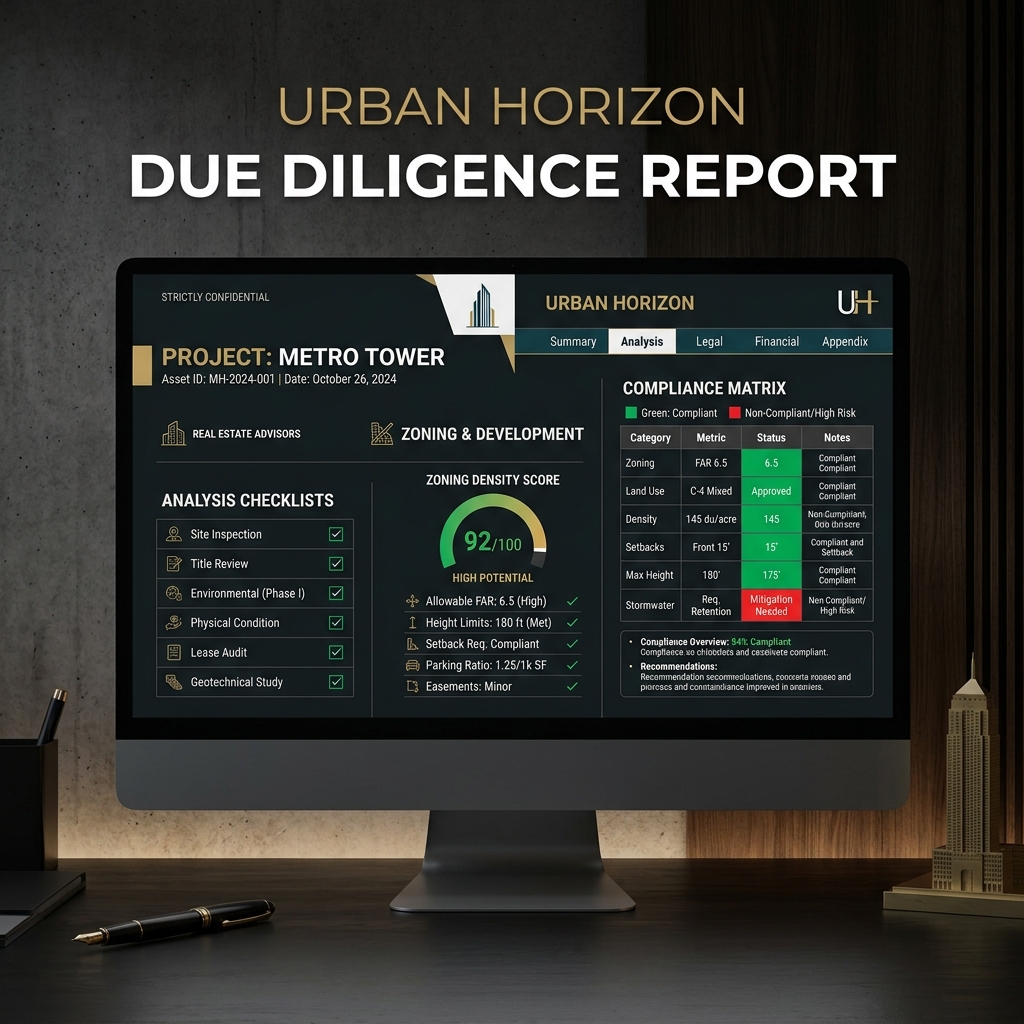
Zoning limits determine the redevelopment value of a site. Our spatial audit engine maps municipal zoning regulations (such as German LBOs or Swiss municipal BZOs) and compares them against current building heights and footprints. The system automatically computes unused development potentials for roof extensions or vertical expansions, checking distance rules, local height limits, and safety paths.
Cross-Border Tax Structuring & Scenario Modeling
Real estate yields are highly sensitive to tax structuring. The PropAI Analyst Tax Simulator models the net yield of holding structures over 30-year investment horizons. The engine compares holding companies, such as German vermögensverwaltende GmbHs (vvGmbH) enjoying trade tax privileges, Swiss companies with long-term capital gains exemptions, and Austrian vehicles subject to ImmoESt, ensuring optimal tax efficiency.
Contractor Liability Auditing & Claim Control
During major refurbishments, change orders and delays can severely erode development margins. Our Contract Audit module monitors construct contract correspondence. It parses contractor communication, logs defect remediation deadlines, and assists in claim prevention by auditing contractor requests against original contract frameworks like VOB/B, SIA-118, or ÖNORM B 2110.
PropAI Analyst vs. Manual Methods
A side-by-side comparison of platform capabilities versus manual processes.
| Feature | PropAI Analyst Platform | Manual Due Diligence |
|---|---|---|
| Underwriting Speed | Automated document parsing and modeling in less than 2 minutes. | Multiple weeks of spreadsheet modeling and manual parsing. |
| Regulatory Audits | Continuous compliance matching for GEG, SIA-118, and ÖNORM rules. | High manual risk of missing regulatory updates or rent caps. |
| Tax Optimizations | Instant cross-border tax scenarios and vvGmbH holding comparisons. | Expensive static tax consultations with no automated calculations. |
| Zoning Assessment | AI-based spatial models mapping local BZOs and LBO distance guidelines. | Manual site checks and expensive pre-assessment archtect fees. |
| ESG Decarbonization | Dynamic CRREM pathways and energetic refurbishment simulation. | Static reports lacking real-time ROI or carbon tax calculations. |
Interactive Regulatory Knowledge Hub
Select a section below to read detailed cross-border regulatory analyses and underwriting guidelines.
Compliance in Europe is a moving target. While the European Union establishes overarching directives, such as the Energy Performance of Buildings Directive (EPBD), the actual enforcement and transposition into national law remain the responsibility of individual member states. Consequently, investors must comply with a patchwork of localized energy codes, tenant protection laws, and building standards.
For instance, a residential asset acquisition in Germany requires strict adherence to the Gebäudeenergiegesetz (GEG) and the VOB/B construction framework. A similar investment in Switzerland demands compliance with SIA-118 and the highly localized Bau- und Zonenordnungen (BZO) of individual cantons and municipalities. In Austria, the Mietrechtsgesetz (MRG) enforces strict rent controls through the Richtwert system, alongside compliance with ÖNORM B 2110 for construction. Each of these regulatory frameworks impacts the asset's cash flow, capital expenditure (CapEx) requirements, and exit valuation. Successful underwriting must account for these localized rules from day one.
PropAI Analyst acts as an automated regulatory gatekeeper. The system continuously updates its database with local building codes and tax regulations across Germany, Switzerland, Austria, and other European markets. By scanning property addresses and regional parameters, the software flags potential non-compliance risks, such as missing energy certificates or potential rent control violations, during the initial screening phase.
Additionally, the EU Taxonomy for sustainable activities imposes strict reporting obligations on financial institutions and fund managers. Properties with poor energy ratings (EPC ratings below C or D) are facing restricted access to debt financing, as European banks prioritize green loans. PropAI Analyst monitors these ESG compliance pathways and flags assets that risk losing their eligibility for institutional refinancing.
Taxation is one of the most critical determinants of net investment performance in European real estate. Cross-border investors must navigate complex tax networks, including corporate income taxes, trade taxes, transfer taxes, and withholding taxes on dividend distributions. Optimizing the holding structure of a real estate portfolio can lead to double-digit differences in net yield.
A common strategy in Germany involves utilizing a vermögensverwaltende GmbH (vvGmbH) to hold real estate assets. By qualifying for the extended trade tax privilege (§ 9 Nr. 1 Satz 2 GewStG), the entity avoids local trade taxes (Gewerbesteuer), reducing the effective corporate tax rate on rental income to just 15.825%. Furthermore, establishing a parent-subsidiary (holding) structure allows for tax-optimized exits. Under § 8b KStG, capital gains from selling shares of a property-holding subsidiary (a Share Deal) are 95% tax-exempt at the holding level, resulting in an effective tax rate of approximately 1.5%. Similar holding structures, such as the SPF in Luxembourg or the Swiss Holding Company, offer comparable benefits, subject to international double taxation treaties (DTTs) and transfer pricing regulations.
However, these structures must be managed with strict economic substance (subsistence and local management) in their respective jurisdictions. PropAI Analyst simulates the cash flows and tax liabilities of various corporate structures over 30-year horizons, helping investors identify the most tax-efficient structure for their specific investment criteria.
International initiatives like the OECD's BEPS (Base Erosion and Profit Shifting) guidelines and the Anti-Tax Avoidance Directive (ATAD) have introduced strict interest barrier rules. These limits restrict the deductibility of interest expenses on shareholder loans, which has traditionally been a primary method for reducing local tax bases. PropAI Analyst helps structure tax-compliant debt-to-equity ratios by simulating ATAD limitations under local tax legislation.
Environmental, Social, and Governance (ESG) criteria are no longer optional compliance tick-boxes; they are core value drivers in the European real estate sector. The European Green Deal mandates a 55% reduction in greenhouse gas emissions by 2030 and full carbon neutrality by 2050. Properties that fail to meet escalating energy efficiency standards face severe stranding risk – the risk of losing value, becoming unrentable, or being hit with punitive carbon taxes.
To manage this risk, institutional investors utilize the Carbon Risk Real Estate Monitor (CRREM) framework. CRREM establishes clear decarbonization pathways for different asset classes and regions, mapping out the maximum allowable carbon intensity (CO2 per square meter per year) over time. If an asset's carbon emissions exceed this pathway, it is considered stranded. Avoiding this requires proactive CapEx planning, including thermal insulation retrofits, window replacements, and transitioning from fossil-fuel heating systems to heat pumps or district heating. These green retrofits not only protect the asset's value but also qualify for green building certifications (such as BREEAM, LEED, or DGNB) and command a green premium in both rental and capital markets.
PropAI Analyst integrates the CRREM methodology directly into its financial modeling engine. The software calculates the exact year of stranding for any given asset based on utility data and building specifications. It then simulates the financial impact of various energetic refurbishment scenarios, calculating the ROI of energy-saving investments and factoring in carbon tax savings and local subsidies.
An important distinction is made between operational carbon (emitted during the active use of the building) and embodied carbon (carbon emissions generated during construction, material manufacturing, and demolition). European regulators are increasingly targeting embodied carbon, making retrofits and vertical expansions (such as roof extensions) much more attractive than demolition and rebuilding. PropAI Analyst helps calculate the embodied carbon footprint of modernization projects to support ESG disclosure requirements.
The speed of underwriting often determines who wins a competitive deal. Traditionally, property underwriting required weeks of manual work: reading through hundreds of pages of sales brochures (exposés), tenancy schedules, land registry extracts, and utility bills. In the digital age, this manual approach is a major bottleneck.
PropAI Analyst leverages advanced Artificial Intelligence and Natural Language Processing (NLP) to automate the entire data ingestion and underwriting process. Our system reads uploaded PDF documents, extracts critical parameters (such as rental income, lease expiry dates, maintenance history, and easement restrictions), and populates the financial model automatically. Furthermore, the platform's machine learning models analyze local market comps, demographic trends, and economic indicators to predict yield compression and rental growth rates. This automated due diligence reduces underwriting times from weeks to minutes, allowing investment teams to analyze more deals and focus on strategic negotiation.
Beyond data extraction, the AI also detects anomalies and hidden risks. For example, it scans land registry documents for unusual easement entries (such as public rights-of-way or heritage protection orders) that could restrict future development. By combining document intelligence with robust financial mathematics, PropAI Analyst provides a complete, risk-adjusted underwriting desk for modern real estate professionals.
Additionally, the system utilizes advanced optical character recognition (OCR) and deep learning to parse historical rent rolls. The AI parses the lease files to detect rent concessions, indexation formulas, and upcoming lease break options. This gives acquisition teams a clear view of the actual lease risk and prevents overestimating the future cash flows of multi-tenant assets.
The shift from a zero-interest-rate environment to higher central bank rates has fundamentally altered the valuation models of European real estate. Capitalization rates (cap rates) have expanded, leading to downward pressure on asset values. In this challenging macroeconomic climate, conservative and highly accurate underwriting is more important than ever.
Investors must focus on defensive underwriting, stressing key assumptions such as vacancy rates, refinancing rates, and inflation-indexed lease adjustments. Relying on generic market averages is no longer sufficient. PropAI Analyst enables comprehensive Monte Carlo simulations, stressing financing costs, interest rate swaps, and CapEx overruns to evaluate the probability of debt service cover ratio (DSCR) and loan-to-value (LTV) covenant breaches. By modeling these downside risks, the platform ensures that investors maintain sufficient liquidity buffers and structure their debt profiles safely.
Furthermore, our refinancing simulator helps evaluate the impact of various interest rate hedges (such as interest rate caps or swaptions). PropAI Analyst stresses these hedging strategies against future yield curves to optimize financing structures, helping developers protect their cash flows from interest rate volatility.
In an increasingly interconnected European economy, geographic diversification has become a vital strategy for mitigating market-specific risks. Investing across different countries – such as balancing high-growth commercial assets in Germany with stable residential assets in Switzerland and yield-optimized properties in Austria – allows institutional portfolios to achieve a smoother risk-return profile. However, managing a multi-jurisdictional portfolio introduces significant operational complexity, as asset managers must monitor disparate regulatory timelines, tax filings, and local compliance standards.
PropAI Analyst addresses this challenge by providing a centralized portfolio management dashboard that harmonizes data across different jurisdictions. The platform translates local metrics into standardized key performance indicators (KPIs), such as Net Operating Income (NOI), Debt Service Coverage Ratio (DSCR), and internal rate of return (IRR), while maintaining full transparency regarding the underlying local variables (such as Swiss Ausnützungsziffer, Austrian Richtwertmietzins, and German building AfA). This enables fund managers to compare performance across borders on an apples-to-apples basis and allocate capital dynamically where risk-adjusted returns are highest.
Furthermore, the platform's risk engine monitors macroeconomic indicators, local legislative updates, and municipal zoning changes in real time. If a municipality in Switzerland updates its BZO or if Austria alters its ImmoESt regulations, the system automatically triggers a portfolio-wide impact assessment, alerting managers to potential valuation changes or refinancing constraints. By combining regulatory intelligence with advanced financial analytics, PropAI Analyst empowers cross-border investors to navigate European real estate with confidence and precision.
Additionally, the integration of predictive analytics allows users to simulate the impact of future climate risks on their assets. PropAI Analyst couples municipal flood zone maps, soil degradation data, and heat stress projections with the property portfolio's physical addresses. The resulting climate vulnerability scores are integrated directly into the underwriting model, allowing investors to adjust their discount rates and capital expenditure budgets proactively. This forward-looking risk management ensures that the portfolio remains resilient against both regulatory shifts and environmental challenges over the long term.